호흡
-외호흡 : 폐 와 혈액 의 기체교환
-내호흡 : 혈액 과 조직의 기체교환
-세포호흡 : 유기물 과 ATP 사이의 세포내 물질 대사
-이화(에너지 방출, 발열 반응)
-동화(에너지 흡수, 흡열 반응)
산화( +O, -H, -e )
환원( -O, +H, +e )
*유기물입장에서
유기물의 C가 산화하게 되면( + O, 산소와 결합하게 되면)
상대적으로 전자가 산소쪽으로 치우치기 때문에
C입장에서는 전자를 잃은 것으로 보고, 에너지를 잃은 것으로 생각.
*유기물의 C가 환원하게 되면 ( + H, 수소와 결합하게 되면)
상대적으로 H의 전자가 C쪽으로 오기 때문에
C입장에서는 에너지를 얻은 것으로 생각.
-> 생명에서
이화반응= 발열 반응= 산화반응= ATP합성
동화반응= 흡열반응= 환원반응=중합체 합성
*완전산화
유기물의 C가 모두 CO2의 형태로 바뀌는 것
<여러가지 대사과정>
우리가 탄수화물을 먹으면 소화과정을 통해 포도당이 됨.
그 포도당이 에너지의 형태로 바뀌기 위해서
(탄수화물의 대사)
1. 해당과정
2. TCA 회로
3. 전자전달계
4. 발효
5.신생합성
6.(지방분해) 베타분해
7.(아미노산분해)
해당과정 glycolysis
포도당이 혈액을 돌아다니다가
glut 를 통해서 세포내로 들어오면
세포내에 효소들에 의해서
기질->산물 연쇄반응 일어나는 것
세포질에서 일어남
kinase 는 ATP써서 인산기 붙인다는 뜻
D-글루코스
헥소카이네이즈 (Hexokinase)
글루코카이네이즈(Glucokinase)
D-6-인산 글루코스 (D-Glucose-6-phoshate, G-6-P)
인산 육탄당 아미소머레이즈 (Phosphoglucoisomerase)
D-6-인산 프럭토스 (D-Fructose-6-phosphate, F-6-P)
프스포프럭토카이네이스 (Phosphofructokinase,PFK-1)
D-1,6-양인산 프럭토스 (D-Fructose-1,6-bisphosphate, FBP)
인산 다이하이드록시아세톤, 3-인산 글리세르 알데히드
(Dihydroxyacetone phosphate, DHAP / D-Glyceraldehyde-3-phosphate, PGAL)
인산 삼탄당 아이소머레이즈 (Trisose phosphate isomerase)
아 잠시만 너무 복잡해서 정리쫌 하고 다시 들어야 겠다
Cellular Respiration
Cellular respiration is a metabolic pathway that uses glucose to produce adenosine triphosphate (ATP), an organic compound the body can use for energy. One molecule of glucose can produce a net of 30-32 ATP.
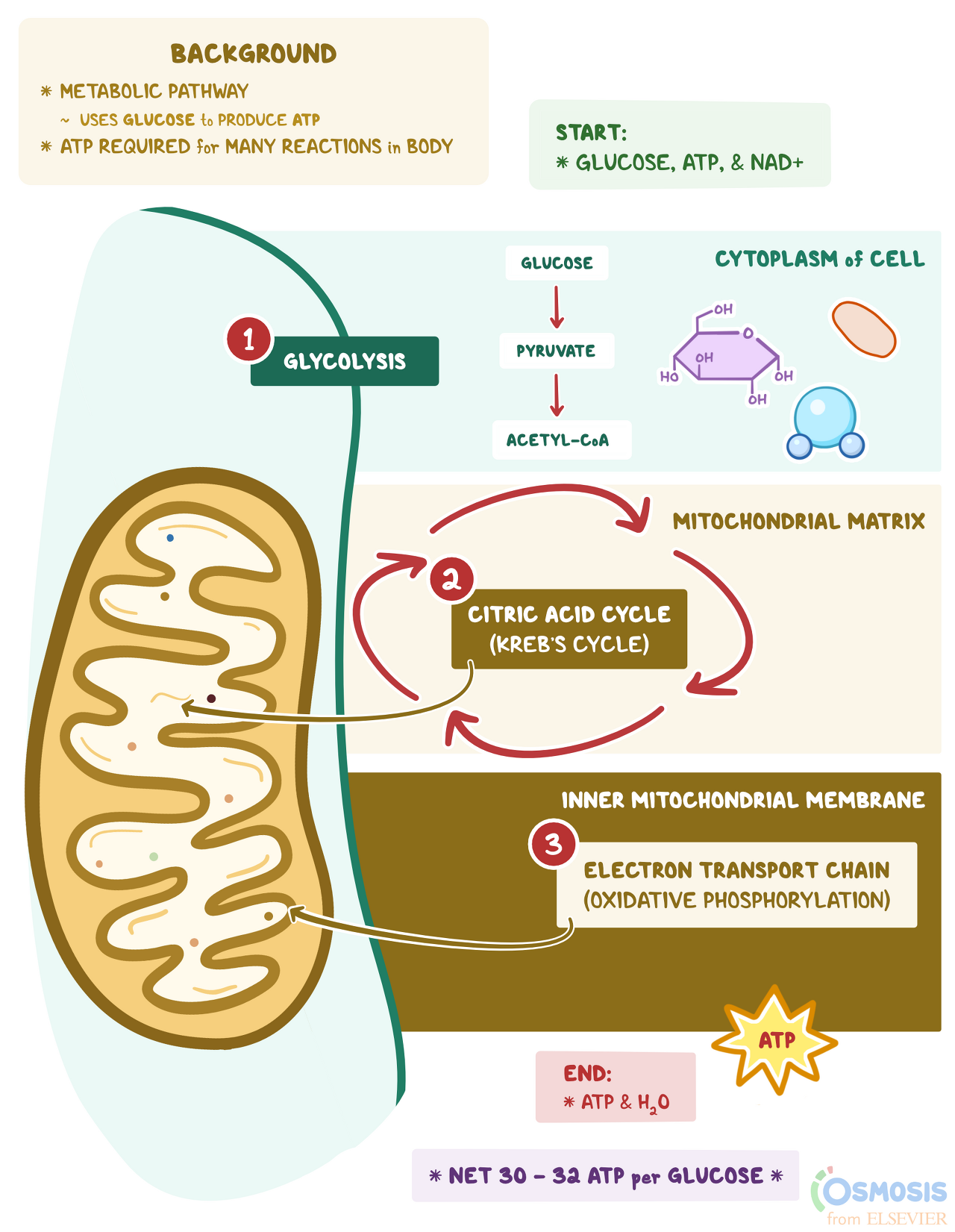
MAIN STEPS of cellular respiration
glycolysis / the citric acid (TCA) or the Krebs cycle / electron transport chain(oxidative phosphorylation)
The TCA cycle and oxidative phosphorylation require oxygen, while glycolysis can occur in anaerobic conditions.
1) Glycolysis is the initial breakdown of glucose to pyruvate, a three-carbon structure, in the cytoplasm.
2)The pyruvate then moves into the mitochondrial matrix where a transition step called pyruvate oxidation takes place.
In this process, pyruvate dehydrogenase converts the three-carbon pyruvate to the two-carbon acetyl-CoA.
3) The TCA cycle begins when acetyl-CoA combines with four-carbon oxaloacetate in order to form the six-carbon citrate. Because each molecule of glucose produces 2 pyruvate molecules, it takes two turns through the Krebs cycle to completely break down the original glucose.
4) Finally, the electron transport chain is a series of redox reactions powered by high-energy electrons that pumps protons across the membrane, creating a proton gradient. Together, an electrochemical gradient is created. At the end of the electron transport chain, the final electron acceptor, O2, combines with protons to produce water (H2O). Meanwhile, ATP synthase uses the movement of protons back into the mitochondrial matrix for ATP synthesis.
REACTANTS of cellular respiration
The reactants of cellular respiration vary at each stage, but initially, it requires an input of glucose, ATP, and NAD+. NAD+, nicotinamide (derived from vitamin B3), is a universal electron acceptor that is crucial in the process of cellular respiration. Another important universal electron acceptor is FAD, (a flavin nucleotide from vitamin B2.) These acceptors are often used in catabolic processes and are reduced into NADH and FADH2, respectively.
Glycolysis requires an input of glucose, two ATP, two ADP, and two NAD+.
Reactants for pyruvate oxidation are pyruvate, NAD+, and coenzyme A (CoA).
One TCA cycle requires acetyl-CoA, one ADP, three NAD+, and one FAD.
oxidative phosphorylation and the electron transport chain use the reactants ADP, NADH, FADH2, and O2.
PRODUCTS of cellular respiration
The whole process of cellular respiration ends up yielding 30-32 ATP per molecule of glucose.
The final end products of cellular respiration are ATP and H2O.
Glycolysis produces two pyruvate molecules, four ATPs (a net of two ATP), two NADH, and two H2O.
When oxygen is present, pyruvate oxidation produces one acetyl-CoA, one NADH, and one CO2 per pyruvate molecule.
The TCA cycle then yields one GTP (i.e., an energy-rich compound similar to ATP used primarily in lower pH environments), three NADH, one FADH2, and two CO2.
NADH and FADH2 can then be used by the electron transport chain to create further ATP as part of oxidative phosphorylation.
Finally, oxidative phosphorylation and the electron transport chain produce 28-30 ATP and 28-30 H2O per glucose.
RATE-DETERMINING ENZYMES in cellular respiration
There are three primary rate-determining enzymes in cellular respiration. These enzymes catalyze the rate-limiting steps, which are the slowest reactions in the series.
The rate-determining enzyme in glycolysis is phosphofructokinase-1, or PFK-1, which converts fructose-6-phosphate to fructose-1,6-bisphosphate. It is stimulated by AMP, fructose-2,6-bisphosphate, and inhibited by ATP and citrate.
Pyruvate oxidation only uses pyruvate dehydrogenase, which is activated by increased NAD+, ADP, or Ca2+.
In the TCA cycle, the rate-determining enzyme is isocitrate dehydrogenase, which converts isocitrate to ɑ-ketoglutarate. The specific reaction is stimulated by ADP and inhibited by ATP and NADH.
DISEASES affect cellular respiration
The most common diseases affecting glycolysis are pyruvate kinase deficiency, erythrocyte hexokinase deficiency, and glucose phosphate isomerase deficiency.
Deficiencies in the pyruvate dehydrogenase enzyme can interfere with pyruvate oxidation. These can result in lactic acidosis characterized by a build-up of lactate and increased serum alanine due to pyruvate build-up that then undergoes fermentation to lactic acid. Children born with these deficiencies may have neurological defects, and management of the disease typically includes keto-diets or diets high in fats.
There are several enzymes in the TCA cycle that may be affected and result in disease, including succinyl-CoA synthase and fumarase. Many individuals with these disorders have involuntary muscle spasms and posture, called dystonia, and are deaf.
Mitochondrial myopathies are genetic disorders that may affect the production of enzymes involved in the electron transport chain or oxidative phosphorylation. These diseases are classically characterized by muscle weakness and fatigue and may include muscular paralysis.
'mD 단기 > 인우' 카테고리의 다른 글
| 인체생리학 입문- 체액 (0) | 2022.10.05 |
|---|---|
| 여성 생식계 (0) | 2022.10.05 |
| 수용기전위 vs 활동전위 (1) | 2022.10.05 |
| 신경계 언어의 중추 (0) | 2022.10.04 |
| 뉴런과 활동전위 (1) | 2022.10.04 |


